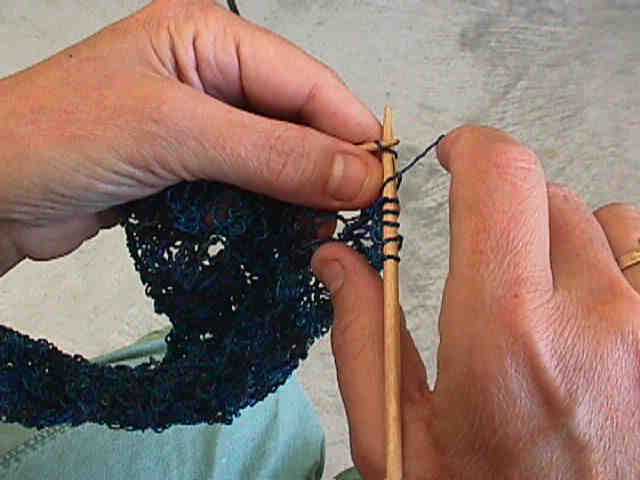
Starting position
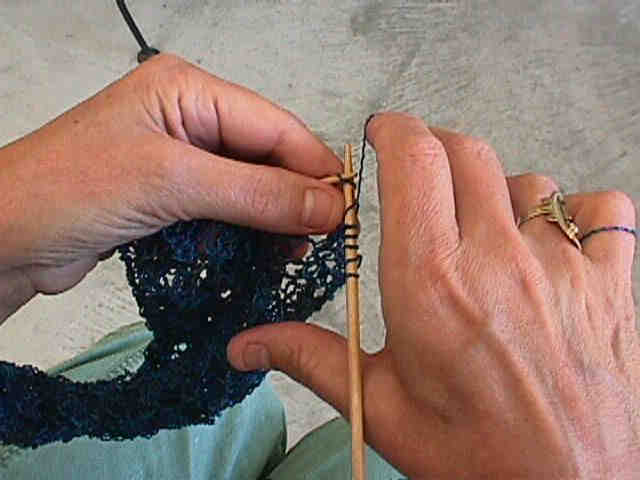
Flex outwards
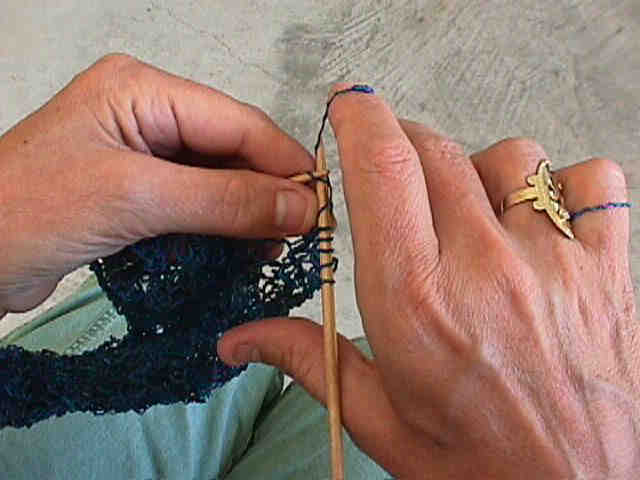
Catch needle point
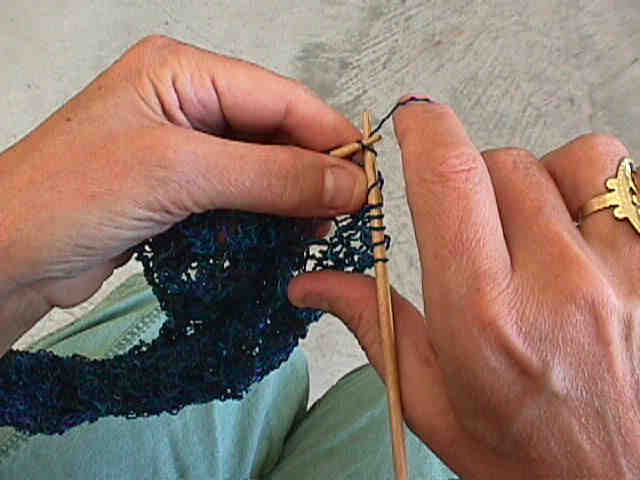
Wrap around point
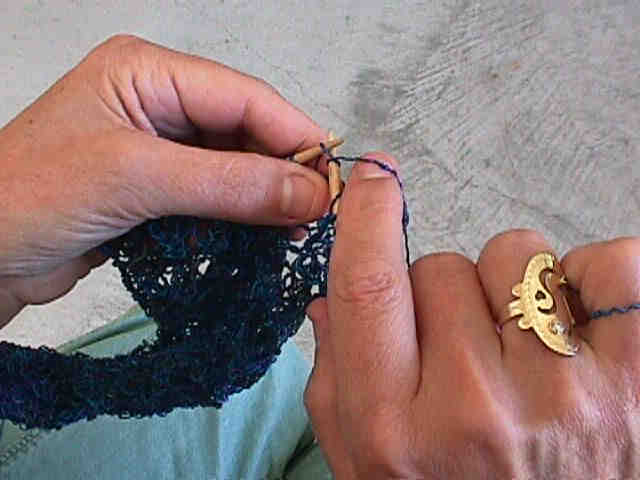
Bring stitch through
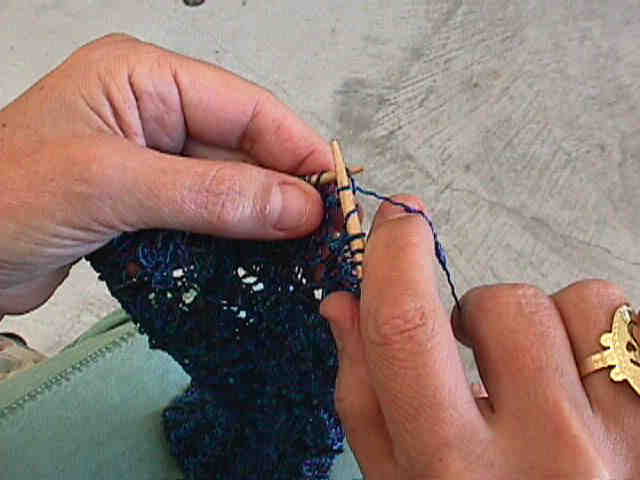
Form new stitch
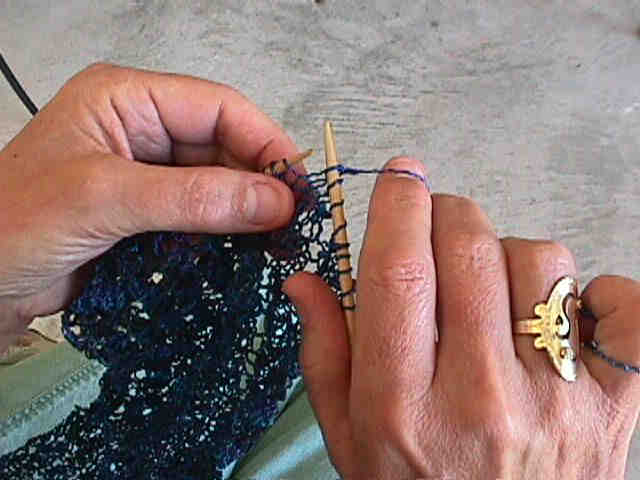
Take new stitch off
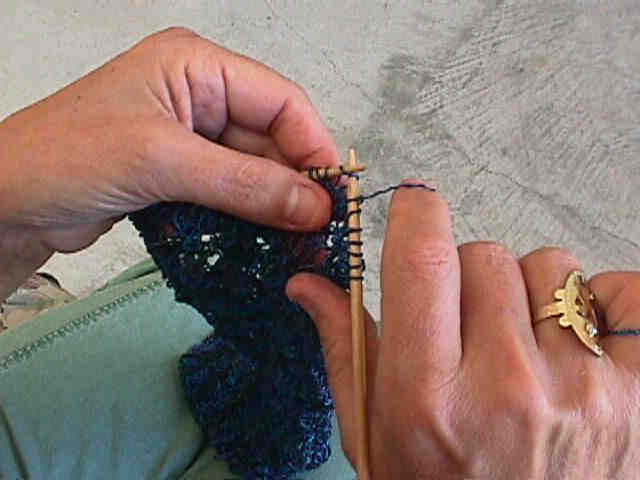
Ready to begin next stitch
My primary knitting method is an English style, but with some differences from what you may have seen in other knitters using this style. There are many, many ways to knit, and even variations within them, so this is not an endorsement of the way I knit. I am describing here, only because so many people have asked. If you are looking to add to, change or refine your repertoire of knitting methods, I hope you find these ideas helpful.
The basic premise is that motion is minimized. Less wasted motion means quicker knitting. Also, a side benefit is the reduction of risk for repetitive motion stress ailments, like carpal tunnel syndrome (CTS).
In the English style of knitting, the yarn is held in the right hand. The technique of getting the yarn around the needle point to form the next stitch is usually referred to as "throwing". In order to accomplish this, many knitters move their entire hand to bring the yarn to and around the needle point. An alternative is to use the index finger like a "lever", and extend outward to bring the yarn to the needle point, then flex slightly sideways and inwards to wrap the yarn around the needle point. Here are thumbnail pictures of the sequence. A fuller explanation, and enlarged pictures are available below. Note: Pictures open in separate window.
|
Starting position
|
Flex outwards
|
Catch needle point
|
Wrap around point
|
|
Bring stitch through
|
Form new stitch
|
Take new stitch off
|
Ready to begin next stitch
|
The photos are also available as an animated sequence prepared by Elaine Norris.
As a comparison, in the Continental, or German style of knitting, the yarn is held in the left hand, and the yarn is "picked" or scooped up by the right-hand needle point. The Continental method reminds me of crocheting, and it is quite natural to me as well. There likewise are efficiency tips that can be applied to this style of knitting by eliminating wasted motion, such as keeping your yarn tensioned close to the needle points.
Repeat these steps for each stitch.
The lever action is accomplished in a similar way for a purl stitch, the difference of course being that the working yarn is held to begin with in front of the right needle, and the right needle tip is inserted from right to left into the front loop of the stitch on the left needle.
The picture sequence can also be viewed in another window as an animated gif. Thanks to Elaine Norris for preparing this animation from the original photos.
I am a slow knitter and was perusing the internet to find ways to improve. It was a zig-zag path that led me to your site, and I am so grateful to learn your lever-action method. My technique is similar but i 'throw' more than I now know is necessary. I learn best by seeing something demonstrated and appreciate your thorough visual for this method. Thank you so much!
Return to Index of Jackie E-S Articles & Tips.
Last revised